What to Check Before Buying a Sofa You Cannot Sit On
A loveseat may look harmless in a showroom photograph, but its dimensions can decide whether it works inside a Singapore flat. A model that appears generous in a display room can block a lift door, foul a corridor turn, or leave no room to open the opposite door. The seating itself may be equally troublesome: a low front rail, unsupported armrests, and cushions that slide can make a “two-seater” uncomfortable for both occupants.

For buyers in Tampines, Bedok, and Punggol, the delivery route matters as much as the fabric. HDB lift openings, condo corridors, turning radii, and service lifts all impose practical limits. Add 5% GST to the listed price, compare delivery charges, and check whether the seller measures the packaged loveseat rather than quoting only its finished size.
This guide explains what to check before buying a sofa you cannot sit on. It covers comfort, construction, access, measurements, and service terms for a solid wood sofa intended for real use. It also shows why a frame can be sturdy while the completed loveseat still fails the sit test.
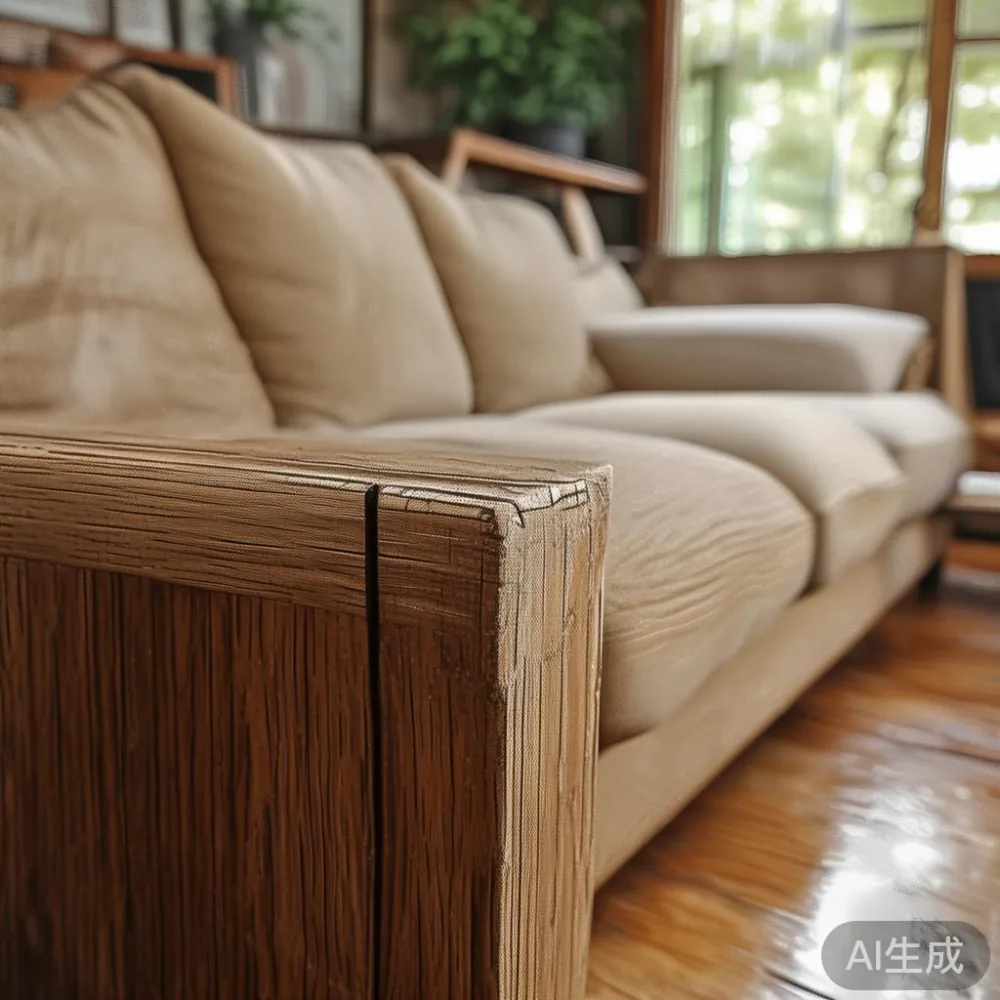
Can You Actually Sit on This Loveseat?
Start with the seat, not the silhouette. A loveseat listed at 150 cm wide may offer only 132 cm of usable seating once the arms and loose cushions are included. Two adults may technically fit, but that does not mean they can sit comfortably for 90 minutes.
Seat height is a useful starting point. Around 42–45 cm suits many adults, while a household with shorter users may prefer 40–43 cm. Deep seats of 58–62 cm can accommodate taller people, but they can leave smaller users sliding forward unless there is a firm back cushion or seat edge. Check that the seat pitch does not force a slouched posture.

Test the arms, back, and cushions in person if possible. The arms should support a hand or forearm without creating a sharp pressure point. The back should meet the seat at a workable angle rather than 90 degrees, and the cushions should resist sliding when you lean forward. A showroom test lasting 10 minutes can reveal more than a photograph; a 30-minute seated test is even more revealing.
Last month I visited my colleague in Bedok with a delivery carton measuring 94 × 68 × 74 cm. The supplier called it a “small loveseat,” yet the packaged body exceeded the usable width of the HDB service lift. We moved the carton to the passenger lift, where the diagonal clearance worked, but the tight 90-degree corridor turn required two people and a 20-minute reposition. That experience shaped the checklist below: finished dimensions are only one part of access planning.
Look for removable or reversible seat cushions, firm foam support, and a back that does not depend entirely on loose filler. If the sofa is sold as a modular loveseat, confirm that each module can pass the lift and that the assembled configuration is stable. A 150 cm width may be assembled from two 75 cm sections, which can make access easier.
Will the Loveseat Fit Through the Lift and Corridor?
Measure the route before ordering. For an HDB flat, ask the building office or management for the internal lift door width, internal car depth, internal car width, and door height. For a condo, check whether the main lobby has a freight lift, whether a service lift booking is required, and whether the route includes a narrow 90-degree turn. Do not assume a passenger lift will accept a furniture carton.
As a planning guide, a rectangular package of 160 × 75 × 60 cm cannot be turned diagonally through every opening. Compare the carton’s longest dimension with the lift car’s usable diagonal, while allowing several centimetres for door hardware, floor rails, and the person guiding it. For narrower routes, request knock-down packaging and ask whether the legs detach. Legs that remove in 4 pieces can reduce the package length by 15–25 cm, although they add assembly time.
Also measure the home itself. Record the entrance width, hallway width, corner clearance, balcony or bedroom doorway, and the intended loveseat position. A common Singapore mistake is to check the room but overlook the route. Keep at least 60 cm of walking space beside a sofa in a busy HDB corridor; in an open-plan living room, allow 75–90 cm between the loveseat and a dining table where possible.
Ask for the packaged dimensions in writing. A supplier quoting 148 × 82 × 76 cm for the bare frame may package it at 158 × 92 × 68 cm. That 10 cm difference can determine whether it enters a lift. Request photographs of the actual carton and clear instructions about palletised delivery, curbside handover, and room-of-choice placement.
Is the “Solid Wood Sofa” Solid Wood Where It Matters?
A solid wood sofa label needs qualification. Check whether the visible frame, arms, legs, back structure, and seat support are solid timber, or whether only the decorative parts are solid wood with plywood or particleboard elsewhere. A mixed construction can still be appropriate, but the seller should disclose it without forcing you to infer the details from a photograph.
Ask for the wood species and moisture treatment. Kiln-dried hardwood used for structural parts is commonly dried to approximately 8–12% moisture, subject to the maker’s specification. Look for joints that resist movement, not simply blocks screwed together at visible points. Through-tenon joints, dowelled joints, and well-fixed corner blocks can support years of use. Avoid relying on a frame description alone; pull up the relevant seat platform and ask how it is joined.
Inspect the finish for cracking, gaps, and an uneven sheen. On a light-luxury piece, small filled marks can be acceptable, but repeated movement around joints suggests an unstable frame. Check that the under-seat area is clean, that there are no exposed nails, and that the cover can be removed. A removable cover is useful in humid Singapore conditions, where ventilation and prompt cleaning matter.
MIDHILL describes a 10-year structural warranty on its solid wood furniture and offers lifetime refinishing for eligible pieces. Those terms are more meaningful when paired with clear documentation. Ask what the warranty covers, how a claim is assessed, and whether wear to cushions, finish changes, or accidental damage is excluded. Keep the invoice and delivery record.
What Does the Warranty and Delivery Promise Actually Cover?
A warranty is useful only if its scope and process are understandable. Confirm whether “structural” covers the frame, joints, and load-bearing components while excluding springs, foam, covers, and routine movement. For a loveseat, ask whether the warranty applies to the complete product or only to select timber components. A stated 10 years should appear on the invoice or warranty document, not merely in a sales conversation.
Check the seat-load rating. A two-person loveseat may be tested for 250 kg, 300 kg, or a higher dynamic load, depending on its design and materials. A written limit provides a clearer basis for household use than a vague statement that the sofa is “strong.” If two adults frequently sit on it, avoid a design intended only for occasional use.
Delivery terms deserve the same attention. Confirm the number of delivery days after the item is ready, whether the quoted service includes carrying, stair climbing, room placement, assembly, and packaging removal. A service priced at SGD 90 may cover curbside delivery only, while SGD 160 may include placement inside the home. Singapore GST at 5% should be shown separately on the final invoice.
MIDHILL offers free shipping for orders over US$350, but international offers are not automatically local Singapore delivery terms. Confirm the SGD price, local delivery charge, installation, and applicable 5% GST before payment. Also review the stated 14-day returns policy, including whether a used or assembled sofa can be returned and who bears return freight. A return route through a service lift can be as restrictive as the original delivery.
Can the Style Suit a Small Singapore Living Room?
Measure the room before selecting a silhouette. Italian light luxury for small living room works best when scale is controlled: slim arms, a restrained base, pale upholstery, and a finish that reflects light without making the room visually crowded. A compact loveseat around 145–165 cm wide can work in many Singapore flats, but its depth and back height may matter more than the headline width.
Leave 80–90 cm between the front of the seat and a coffee table. For a 160 cm loveseat with a 58 cm seat depth, position the table so that a seated person can reach it without standing. Check that nearby doors do not clash with the arms. In a narrow HDB living room, a loveseat with a depth below 90 cm may preserve a more usable path than a deeper American light luxury design.
French provincial styling can add character through shaped arms, gentle curves, and neutral linen tones, though reproduction details can make a small room feel heavy. Post-modern light luxury offers another route through clean lines, balanced proportions, and subtle material contrast. The right choice should still respect circulation space, not just match a mood board.
Texture and colour influence the perception of scale. A dark, strongly patterned loveseat may occupy more visual space than a pale one. Test swatches under daylight and evening lighting. If the model has marble table styling nearby, keep the contrast controlled; the table should not compete with the loveseat. The same discipline applies when considering a bed frame, dining table, wardrobe, or nightstand: each piece should support the room rather than fill it.
Can the Loveseat Be Moved, Cleaned, and Repaired?
Ask whether the loveseat has replaceable cushion covers, washable materials, and accessible under-seat components. In Singapore’s humidity, solid wood may move slightly with seasonal changes. A well-designed joint allows controlled movement, while tight, brittle joints can crack. Lift the front of the sofa by a few centimetres and listen for scraping, knocking, or unequal resistance; a minor, even sound can be less worrying than a sharp creak.
Check weight before arranging a move. A compact solid wood loveseat may weigh 55–75 kg, while a larger framed version may reach 95–120 kg. Confirm whether the supplier includes carry-in and whether the team can move it to a specific room. For stairs, ask about surcharges and the minimum landing width. Never rely on one person to carry a package over 60 kg through a lift.
Consider future repair and refinishing. A 10-year structural warranty can be reassuring, while lifetime refinishing adds value if the supplier can explain which surfaces are eligible, the expected turnaround, and the cost of transporting the item. Find out whether upholstery can be replaced without replacing the whole loveseat. A platform with screwed or dowelled components can be serviced more readily than one designed for disposal.
Designers sometimes search for for sale Nordic furniture or a Mid-century modern dining table when completing a home. Those choices can complement a compact loveseat, but coordinate proportion and finish rather than matching unrelated trends. A solid timber dining table, pale walls, and one deliberate accent cushion can make a small room feel composed. Coastal for dining room styling may suit bright HDB interiors, provided the furniture remains durable and easy to maintain.
What Questions Should You Ask Before Paying?
Ask the supplier for the finished dimensions, usable seat dimensions, packaged dimensions, frame material, seat-load rating, warranty document, delivery scope, and return conditions. Photograph each response. Confirm whether the quoted loveseat includes the listed legs and cushions; low showroom models may be displayed with different feet or loose back cushions.
Ask where the sofa will be assembled and whether delivery is curbside or room-of-choice. Confirm the expected delivery window in calendar days and what happens if the first attempt fails because the access route differs from the measurements supplied. A reputable seller should discuss a failed delivery before it occurs, not after a carton is already at the block.
Before payment, walk the intended route with a tape measure. Compare each pinch point with the packaged data. Check that the sofa can be tilted without striking a ceiling sprinkler or corridor light, and that the lift can carry its weight within its posted limit. Then sit on the loveseat if a sample is available.
Buying a sofa you cannot sit on is usually the result of skipping one of three checks: physical comfort, structural transparency, or physical access. A beautiful silhouette does not compensate for a 38 cm seat height, a 165 cm package that cannot clear the lift, or a warranty with unclear exclusions.
For a guest bedroom or multipurpose room, the phrase Modern for guest room can guide the search toward a compact, visually adaptable loveseat with a firm seat and manageable depth. Pair it with a slim nightstand, a narrow bed frame, and enough clearance to open the door. The goal is not merely to complete the room, but to make every centimetre usable.
A disciplined purchase starts with numbers: 150 cm of width, 45 cm of seat height, 65 kg of package weight, 12 delivery days, 10 years of structural coverage, and 14 days for a return review. Those details turn style into a practical decision. Once comfort, construction, and access align, the loveseat becomes furniture for everyday life rather than a bulky object that merely fits the photograph.